
Polished concrete is becoming a more popular and sought after finish for all types of projects. For many years it was usually only seen in massive warehouse, box store, or supermarket scale projects given the significant amount of labor involved in the process. Only with huge square footages could the price per foot remain within the budget’s limits. With newer polishing systems, the work time has decreased making it a more viable option for time-restricted commercial and industrial projects.
More important than time to install however is the quality of the finish. After all, this is what is being delivered to the client and what their customers or employees will experience day to day. For decades, the final smoothness and appearance of the polished surface was usually determined by the experience of the foreman or project manager. With nothing else to go on, the smoothness of each step was determined by eye and touch. Anyone who has attempted to gauge the smoothness of 50,000 square feet of concrete floor during every step of a polishing process can attest to the difficulty of keeping smoothness uniform throughout.
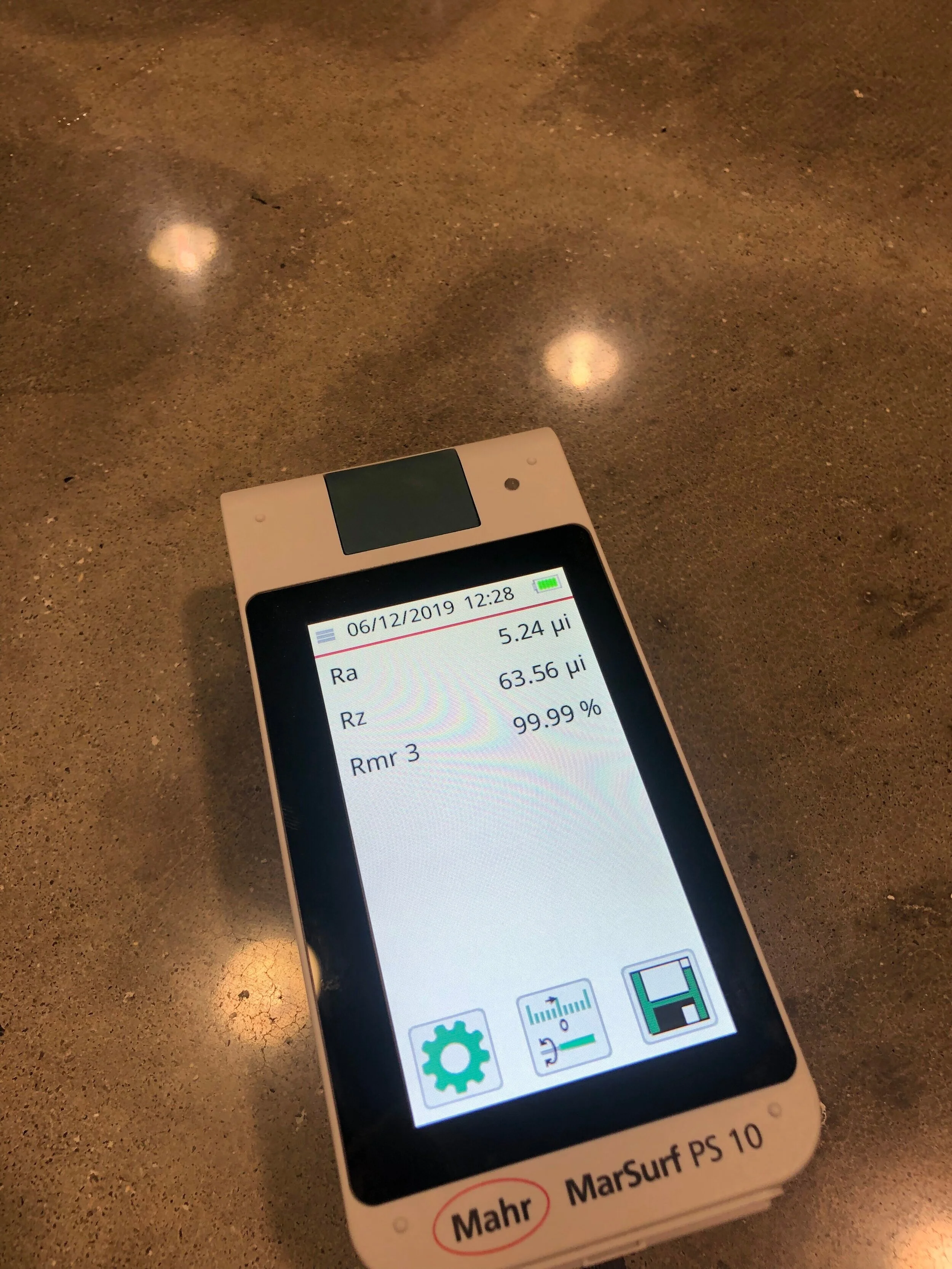
This is where the concept of “Ra” comes in. Put simply, it is the average roughness of the spot being measured. Using an Ra meter allows the user to measure the smoothness at the micro-inch level and determine if the polishing process can move onto the next step, or if continued refinement is needed before progressing. Done properly, this eliminates the need to rely on one person’s estimation, and turns a once subjective observation into an objective measurement.
The Ra of glass generally measures from 0-5. Done well, a polished concrete floor can achieve Ra between 0-36, with common results around 3-10. The next time you are accepting bids for a concrete polishing project or considering one for your home or business, be sure to ask the polishing contractor if they use Ra to ensure a high quality result.